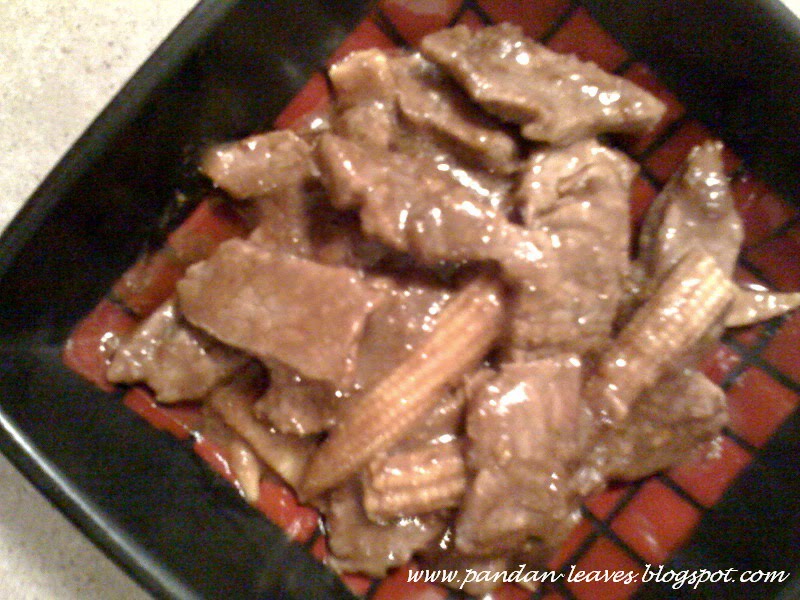
My friend, Andy, and I used to go to a Chinese restaurant in downtown Akron when we were in college. We often ordered the Sa Cha Beef. This dish was not on the menu, but we go there often enough that they will make the dish for us. Because both Andy and I don't like spinach (or I don't like greens in general, at the time), we would ask for baby corns. So, here's my rendition of Sa Cha Beef with baby corns.
Sa Cha Beef
1 lbs of beef tenderloin
Baby corns
Marinade:
1 tbsp of water
1 tsp of cornstarch
Sauce Mix:
2 1/2 tbsp of Sa Cha Sauce
1 1/2 tbsp of premium oyster sauce
1/2 tsp of sugar
1/2 tsp of cornstarch
Marinade beef for 15 minutes.
Stir fry beef with 1 - 2 tbsp of oil until done. Pour in the sauce mix and heat through. Add in baby corns and stir well.
Serve warm.
Jun 30, 2010
Jun 28, 2010
Sesame Oil Chicken
After a whole week of eating out, I was craving for some comforting home cook meal... and stumbled upon the recipe for Sesame Oil Chicken on rasamalaysia.com.
As a picture tells a thousand stories, you can tell that my sesame oil chicken turned out quite dry. It was not intended. I had let the chicken over-shimmered while I was focusing on writing a report. Again, an evidence that patience and attention are the virtues I lack. Nonetheless, the chicken did turned out to be tender. I'll have to settle for having some home cook meal.
Sesame Oil Chicken
http://rasamalaysia.com/recipe-sesame-oil-chicken/
As a picture tells a thousand stories, you can tell that my sesame oil chicken turned out quite dry. It was not intended. I had let the chicken over-shimmered while I was focusing on writing a report. Again, an evidence that patience and attention are the virtues I lack. Nonetheless, the chicken did turned out to be tender. I'll have to settle for having some home cook meal.
Sesame Oil Chicken
http://rasamalaysia.com/recipe-sesame-oil-chicken/
Jun 26, 2010
Herbal Beggar's Chicken
I came to realized that the past couple of months has been onerous physically and I can only imagine that the month of June would take it to the next level. It reminded me of those days when I was still living at home with Ah Po, where she would make herbal teas every now and then for us. She would put them out and make me drink them. It's one of those things that I took for granted, being skeptical that those herbal stuff doesn't do anything... but they do taste good, most of the time. Only after leaving home, I realized that the herbal teas that Ah Po made did have medicinal benefits.
So, in the attempt of repairing my body and health and getting them ready for the month of June, I opted for Herbal Beggar's Chicken. I must say that the fragrance imparted while the chicken is steaming was quite beatificus. Not to mention, the chicken did turn out to be very juicy and tender. Hmmm.... yummilicious!
Herbal Beggar's Chicken
1 whole chicken (preferably kampung chicken)
Cling film paper
Parchment paper
Seasoning A:
1/4 tsp of salt
1/4 tsp of pepper
1/2 tbsp of Xiaoshing wine
1/2 tbsp of sesame oil
Seasoning B:
1 tsp of sugar
1/4 tsp of pepper
1 tbsp of light soy sauce
1 tsp of dark soy sauce
1 tsp of Xiaoshing wine
1/2 tbsp of sesame oil
Herbs:
4 slices of tong kwai
3 slices of pak kei
10 g of tong sum
10 g of wai sun
4 red dates, pitted
Thickening:
1 tsp of cornstarch
2 tbsp of water
Rinse the chicken, drain well. Rub seasoning A on the skin. Combine seasoning B in a small bowl and rub the inside or cavity of the chicken.
Rinse all the herbs and place in a small bowl. Steam for 10 - 15 minutes.
Stuff the herbs into the cavity of the chicken. Wrap the chicken with cling film wrap and refrigerate for 2 - 3 hours.
Remove the cling film wrap and place the chicken on 2 sheets of parchment papers. Wrap up neatly and tuck in the edges. Put chicken in a deep dish and steam over medium heat for 1 - 1.25 hours or until chicken is almost tender.
Reserve the chicken stock and bring to boil. Then, thicken with cornstarch mixture. Pour over the chicken and serve.
So, in the attempt of repairing my body and health and getting them ready for the month of June, I opted for Herbal Beggar's Chicken. I must say that the fragrance imparted while the chicken is steaming was quite beatificus. Not to mention, the chicken did turn out to be very juicy and tender. Hmmm.... yummilicious!
Important herbs
Chicken came out from steaming
Need to hang out with cooks at kopitiam to learn chicken-chopping-skills!
Herbal Beggar's Chicken
1 whole chicken (preferably kampung chicken)
Cling film paper
Parchment paper
Seasoning A:
1/4 tsp of salt
1/4 tsp of pepper
1/2 tbsp of Xiaoshing wine
1/2 tbsp of sesame oil
Seasoning B:
1 tsp of sugar
1/4 tsp of pepper
1 tbsp of light soy sauce
1 tsp of dark soy sauce
1 tsp of Xiaoshing wine
1/2 tbsp of sesame oil
Herbs:
4 slices of tong kwai
3 slices of pak kei
10 g of tong sum
10 g of wai sun
4 red dates, pitted
Thickening:
1 tsp of cornstarch
2 tbsp of water
Rinse the chicken, drain well. Rub seasoning A on the skin. Combine seasoning B in a small bowl and rub the inside or cavity of the chicken.
Rinse all the herbs and place in a small bowl. Steam for 10 - 15 minutes.
Stuff the herbs into the cavity of the chicken. Wrap the chicken with cling film wrap and refrigerate for 2 - 3 hours.
Remove the cling film wrap and place the chicken on 2 sheets of parchment papers. Wrap up neatly and tuck in the edges. Put chicken in a deep dish and steam over medium heat for 1 - 1.25 hours or until chicken is almost tender.
Reserve the chicken stock and bring to boil. Then, thicken with cornstarch mixture. Pour over the chicken and serve.
Jun 8, 2010
Fragrant Spare Ribs
Feels like a good day for some fried, tender spare ribs...
Fragrant Spare Ribs
750 gms of spare ribs
2 tbsp of oil
1 tbsp of sesame oil
1 tbsp of rose wine
1 big piece of aluminium foil
Marinade for spare ribs:
1 tbsp of light soy sauce
1 tsp of salt
1 tsp of sugar
1/2 tsp of pepper
1/2 tsp of Chinese five spice powder
1 tbsp of custard powder
1 tsp of flour
1 tsp of corn flour
3 tbsp of water
Sauce (combined):
1 tbsp of light soy sauce
1 tbsp of oyster sauce
2 tbsp of sugar
1 tbsp of tomato sauce
1 tbsp of black vinegar
1 tbsp of Worcestershire sauce
1 tbsp of chilli sauce
1 tsp of custard powder
1/2 cup of water
1 tbsp of sesame oil
Cut spare ribs into 1 - 2 inch lengths. Rinse and drain well on paper towels. Season with marinade for several hours or preferably overnight in the refrigerator.
Deep fry the spare ribs in hot oil until golden brown. Remove and drain from oil.
Heat 2 tbsp of oil and 1 tbsp of sesame oil in a wok. Add in sauce ingredients and bring to a low simmering boil. Put in pre-fried spare ribs. Toss well until evenly coated with sauce.
Remove spare ribs and sauce out onto a piece of aluminium foil. Add in the rose wine and wrap up neatly into a package.
Place the package on a Pyrex dish and steam for 1 hour or until spare ribs turn tender.
Fragrant Spare Ribs
750 gms of spare ribs
2 tbsp of oil
1 tbsp of sesame oil
1 tbsp of rose wine
1 big piece of aluminium foil
Marinade for spare ribs:
1 tbsp of light soy sauce
1 tsp of salt
1 tsp of sugar
1/2 tsp of pepper
1/2 tsp of Chinese five spice powder
1 tbsp of custard powder
1 tsp of flour
1 tsp of corn flour
3 tbsp of water
Sauce (combined):
1 tbsp of light soy sauce
1 tbsp of oyster sauce
2 tbsp of sugar
1 tbsp of tomato sauce
1 tbsp of black vinegar
1 tbsp of Worcestershire sauce
1 tbsp of chilli sauce
1 tsp of custard powder
1/2 cup of water
1 tbsp of sesame oil
Cut spare ribs into 1 - 2 inch lengths. Rinse and drain well on paper towels. Season with marinade for several hours or preferably overnight in the refrigerator.
Deep fry the spare ribs in hot oil until golden brown. Remove and drain from oil.
Heat 2 tbsp of oil and 1 tbsp of sesame oil in a wok. Add in sauce ingredients and bring to a low simmering boil. Put in pre-fried spare ribs. Toss well until evenly coated with sauce.
Remove spare ribs and sauce out onto a piece of aluminium foil. Add in the rose wine and wrap up neatly into a package.
Place the package on a Pyrex dish and steam for 1 hour or until spare ribs turn tender.
Jun 4, 2010
Mee Siam
I'm starting to noticed that I've been cooking quite a bit of those spicy dishes. Here's another one - Mee Siam or Siamese-style noodles. Only when I started to dig in, I realized that I have overdid the gravy by adding 2 more tbsp of chili paste than what was called for... I was sweating when it was all over! On the bright side, it is summer now. The spiceness certainly helps with taking off the heat. And nothing could have make it any much better to top it off than a bowl of pulut hitam for dessert :)
Mee Siam
2 lbs of lo mein
2 lbs of fresh whole shrimp, reserve heads and shells for stock
3 1/2 cups of water
salt to taste
1 cup of cooking oil
10 cloves of garlic, chopped
6 soy bean cakes, diced
2 tbsp of salted soy beans, mashed to paste, or Miso paste
4 tbsp of light soy sauce
1 lb of fresh bean sprouts
6 - 8 stalks of scallions, cut into 1 inch lengths
20 shallots, thinly sliced, fried golden brown
4 eggs, hardboiled, quartered
6 red Serrano chillies, seeded, thinly sliced diagonally (optional)
10 limau kasturi/calamansi limes, cut into halves (subs. key limes cut into small wedges)
Sauce:
2 tbsp of cooking oil
12 cloves of garlic, pounded
3 tbsp or to taste, sambal olek/chili paste
3 tbsp of salted soy beans, mashed to paste, or Miso paste
3 tsp of sugar
3 1/2 cups of coconut milk
1/2 cup of tamarind paste, made from 3 - 3 1/2 oz of tamarind pulp mixed well with 1/2 cup of hot water, strained to remove seeds
To prepare sauce:
Heat oil on high, add garlic, sambal olek, salted soy bean paste or Miso paste, stir fry for about a minute.
Add sugar, tamarind paste, and coconut milk, reduce heat to med-low.
Simmer till oil starts to float on top, add salt to taste.
Keep gravy hot on low-med heat, for serving.
Dish out into gravy bowl when serving.
To prepare noodles:
Soak dried lo mein in hot water till al dente, drain, run under cold running water, drain well and set aside.
Remove shells from shrimp. Reserve shells and heads, roughly pound.
Bring 3 1/2 cups of water to a boil. Add shrimp shells and heads, simmer. Reduce to 1 cup of stock, strain and discard shells and heads. Add salt to taste.
In a wok, heat 1 cup of oil, fry shallots till golden brown. Drain on paper towels and set aside for garnish.
Remove all but 2 tbsp of oil from wok. Add garlic, stir fry till golden brown and crisp.
Add shrimps, soy bean cakes, 2 tbsp of salted soy bean paste or Miso paste. Stir fry 1 - 2 minutes.
Add shrimp stock, soy sauce, and bring to a boil. Reduce heat to medium, cover and simmer for about 5 minutes.
Add noodles and stir fry for 3 - 5 minutes.
Add bean sprouts, scallions, and salt to taste. Stir fry for 1 - 2 minutes. Turn off heat.
Dish noodles into individual serving bowls.
Garnish with hardboiled eggs, fried shallots, and freshly sliced red chillies (optional).
Serve with gravy bowl on the side, for pouring a little over noodles while eating.
Mee Siam
2 lbs of lo mein
2 lbs of fresh whole shrimp, reserve heads and shells for stock
3 1/2 cups of water
salt to taste
1 cup of cooking oil
10 cloves of garlic, chopped
6 soy bean cakes, diced
2 tbsp of salted soy beans, mashed to paste, or Miso paste
4 tbsp of light soy sauce
1 lb of fresh bean sprouts
6 - 8 stalks of scallions, cut into 1 inch lengths
20 shallots, thinly sliced, fried golden brown
4 eggs, hardboiled, quartered
6 red Serrano chillies, seeded, thinly sliced diagonally (optional)
10 limau kasturi/calamansi limes, cut into halves (subs. key limes cut into small wedges)
Sauce:
2 tbsp of cooking oil
12 cloves of garlic, pounded
3 tbsp or to taste, sambal olek/chili paste
3 tbsp of salted soy beans, mashed to paste, or Miso paste
3 tsp of sugar
3 1/2 cups of coconut milk
1/2 cup of tamarind paste, made from 3 - 3 1/2 oz of tamarind pulp mixed well with 1/2 cup of hot water, strained to remove seeds
To prepare sauce:
Heat oil on high, add garlic, sambal olek, salted soy bean paste or Miso paste, stir fry for about a minute.
Add sugar, tamarind paste, and coconut milk, reduce heat to med-low.
Simmer till oil starts to float on top, add salt to taste.
Keep gravy hot on low-med heat, for serving.
Dish out into gravy bowl when serving.
To prepare noodles:
Soak dried lo mein in hot water till al dente, drain, run under cold running water, drain well and set aside.
Remove shells from shrimp. Reserve shells and heads, roughly pound.
Bring 3 1/2 cups of water to a boil. Add shrimp shells and heads, simmer. Reduce to 1 cup of stock, strain and discard shells and heads. Add salt to taste.
In a wok, heat 1 cup of oil, fry shallots till golden brown. Drain on paper towels and set aside for garnish.
Remove all but 2 tbsp of oil from wok. Add garlic, stir fry till golden brown and crisp.
Add shrimps, soy bean cakes, 2 tbsp of salted soy bean paste or Miso paste. Stir fry 1 - 2 minutes.
Add shrimp stock, soy sauce, and bring to a boil. Reduce heat to medium, cover and simmer for about 5 minutes.
Add noodles and stir fry for 3 - 5 minutes.
Add bean sprouts, scallions, and salt to taste. Stir fry for 1 - 2 minutes. Turn off heat.
Dish noodles into individual serving bowls.
Garnish with hardboiled eggs, fried shallots, and freshly sliced red chillies (optional).
Serve with gravy bowl on the side, for pouring a little over noodles while eating.
May 31, 2010
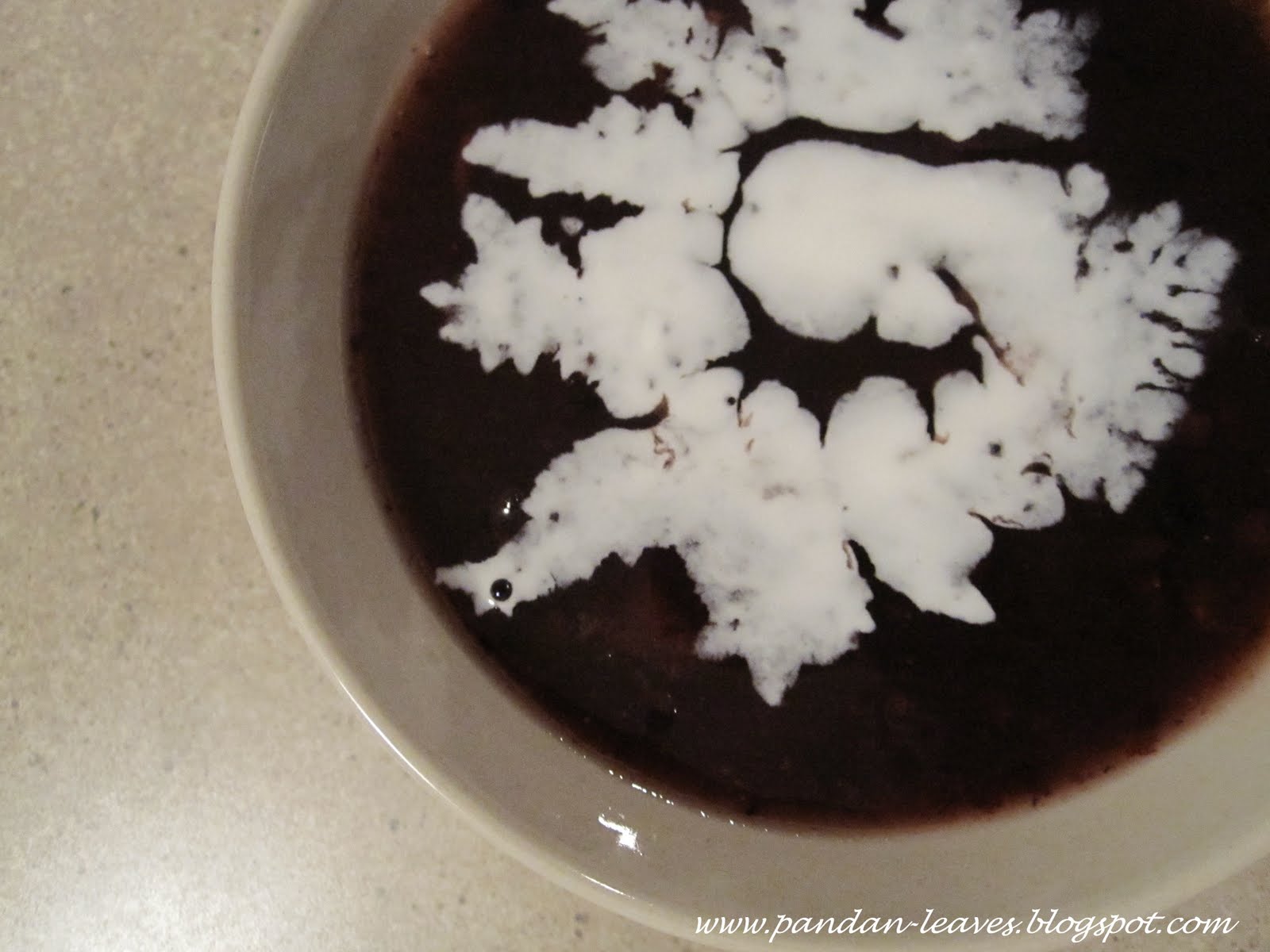
Love Love Love Pulut Hitam
I don't remember liking pulut hitam as much when I was back home in Malaysia. I would probably have gotten lin chee kang or something else. But pulut hitam has become my favorite here, probably because it's one that I can generally get from a Malaysian restaurant. It is likely that I was at Nyonya in NYC a few years back, getting my Malaysian food fix, and when I tasted the pulut hitam, I was in love. Ever since then, I would always, always get my pulut hitam fix when I'm in NYC.
The process of making pulut hitam is not difficult; just long. It took hours of boiling before the black glutinuos rice becomes soft and creamy. Surprisingly to me though, the initial boiling of the black glutinuos rice imparts a wonderful aroma, just like that of pandan leaves, which confused me for a second because I thought that I had put in the pandan leaves when I'm not supposed to!
There's also different recipes for pulut hitam out there. Some add dried longans. But I have left that out. In fact, I don't much fancy the coconut milk on top of pulut hitam. I did it just for the sake of a picture here ;p
When I get to taste my very own first spoonful, well, just..... OH. SO. GOOD.
Pulut Hitam (Black Glutinuos Rice Dessert)
300 gms of black glutinuos rice
4 liters of water
150 gms of castor sugar
100 gms of palm sugar
3 - 5 pandan leaves, knotted *clearly, I'm obsessed with pandan leaves*
2 tbsp of cornstarch
3 tbsp of water
1/2 tsp of salt
1 can of coconut milk, for topping
Wash glutinuos rice until water runs clear. Leave rice to soak in water for 2 - 3 hours or best overnight in the refrigerator.
Put rice and water in a deep pot and cook over medium heat until rice is soft and creamy.
When reach the desired creamy consistency. add pandan leaves.
Add powdered sugar, palm sugar, and salt.
Simmer for another 10 - 15 mins.
In a small bowl, mix the cornstarch and water. Add the cornstarch slurry into the rice, keep stirring.
As soon as boil is reached, remove from heat.
Ladle into dessert bowl, swirl 2 - 3 tbsp of coconut milk on top.
Serve warm.
The process of making pulut hitam is not difficult; just long. It took hours of boiling before the black glutinuos rice becomes soft and creamy. Surprisingly to me though, the initial boiling of the black glutinuos rice imparts a wonderful aroma, just like that of pandan leaves, which confused me for a second because I thought that I had put in the pandan leaves when I'm not supposed to!
There's also different recipes for pulut hitam out there. Some add dried longans. But I have left that out. In fact, I don't much fancy the coconut milk on top of pulut hitam. I did it just for the sake of a picture here ;p
When I get to taste my very own first spoonful, well, just..... OH. SO. GOOD.
Pulut Hitam (Black Glutinuos Rice Dessert)
300 gms of black glutinuos rice
4 liters of water
150 gms of castor sugar
100 gms of palm sugar
3 - 5 pandan leaves, knotted *clearly, I'm obsessed with pandan leaves*
2 tbsp of cornstarch
3 tbsp of water
1/2 tsp of salt
1 can of coconut milk, for topping
Wash glutinuos rice until water runs clear. Leave rice to soak in water for 2 - 3 hours or best overnight in the refrigerator.
Put rice and water in a deep pot and cook over medium heat until rice is soft and creamy.
When reach the desired creamy consistency. add pandan leaves.
Add powdered sugar, palm sugar, and salt.
Simmer for another 10 - 15 mins.
In a small bowl, mix the cornstarch and water. Add the cornstarch slurry into the rice, keep stirring.
As soon as boil is reached, remove from heat.
Ladle into dessert bowl, swirl 2 - 3 tbsp of coconut milk on top.
Serve warm.
May 29, 2010
Fried Pomfret with Ginger
I love fish. And for that, Ah Po spread a rumor about eating fish makes people smart to convince my nephew and niece to eat more fish!
Fried pomfret with ginger is one of most favorite dish and Ah Po used to make it a lot for me. It's a simple dish but yet, so delicious and you'll never resist sucking on the salty yet sweet, crispy fins (except when they're burned as in mine). My attempt on this dish didn't turn out as crunchy and crispy the way Ah Po made it. In fact, there's sporadic areas that burned more so than the others; perhaps I didn't coat the fish with cornstarch evenly...? And if she sees the ginger that I julienned, she'd be shock!
Fried Pomfret with Ginger
1 white pomfret, gutted, cleaned, wiped dry and sprinkled with salt
1 tbsp of cornstarch
4 tbsp of julienned ginger
1 tbsp of soy sauce
1 tbsp of sugar
Oil for frying
Coat the salted fish with cornstarch.
Heat wok and add oil when the wok is shimmering hot.
Lower the fish into the oil carefully to avoid splattering.
Fry until golden brown before flipping and fry the other side of the fish until golden brown too.
Remove fish and place on serving plate.
Remove all oil except 2 tbsp.
Fry the julienned ginger until crispy. Remove and place on top of the fish.
Add soy sauce and sugar to the oil in the wok and cook till it thickens.
Spoon over the fish.
Serve hot with white rice.
Fried pomfret with ginger is one of most favorite dish and Ah Po used to make it a lot for me. It's a simple dish but yet, so delicious and you'll never resist sucking on the salty yet sweet, crispy fins (except when they're burned as in mine). My attempt on this dish didn't turn out as crunchy and crispy the way Ah Po made it. In fact, there's sporadic areas that burned more so than the others; perhaps I didn't coat the fish with cornstarch evenly...? And if she sees the ginger that I julienned, she'd be shock!
Fried Pomfret with Ginger
1 white pomfret, gutted, cleaned, wiped dry and sprinkled with salt
1 tbsp of cornstarch
4 tbsp of julienned ginger
1 tbsp of soy sauce
1 tbsp of sugar
Oil for frying
Coat the salted fish with cornstarch.
Heat wok and add oil when the wok is shimmering hot.
Lower the fish into the oil carefully to avoid splattering.
Fry until golden brown before flipping and fry the other side of the fish until golden brown too.
Remove fish and place on serving plate.
Remove all oil except 2 tbsp.
Fry the julienned ginger until crispy. Remove and place on top of the fish.
Add soy sauce and sugar to the oil in the wok and cook till it thickens.
Spoon over the fish.
Serve hot with white rice.
May 24, 2010
Daging Masak Merah (Red Cooked Meat) with Nasi Tomato (Tomato Rice)
One of the things that I looked forward to at a Malay wedding back home, besides the happy couple, is the food. The variety of colors, smells, tastes...
This dish is commonly cooked with chicken, but I've decided to make it with beef and hence, daging masak merah. It is aboslutely hot and spicy (even to my standard!), yet incredibly appetizing especially paired with the tomato rice. However, my tomato rice turned out to be slightly on the damp side. I think that if I had used basmati rice or less water with jasmine rice, it would have turned out better. Perhaps next time!
Daging Masak Merah (Red Cooked Meat)
2 lbs of beef
2 tbsp of turmeric powder
1 tbsp of salt
1 cup of red onions, chopped
2 tbsp of ginger, grated
4 cloves of garlic, minced
6 oz of tomato puree
1 cup of chili paste (sambal olek)
3 tbsp of Sriracha hot chili sauce
1 cup of tomato ketchup
2 tbsp of sweet dark soy sauce
1 large onion, cut into rings
1/2 tbsp of sugar
salt to taste
2 cups of water
3 - 4 kaffir lime leaves (subs. zest of 1 lime)
2 - 3 pandan leaves (optional)
Lightly coat stew beef pieces with turmeric powder and salt. Marinate for at least 30 mins.
Heat wok on high. Add sufficient vegetable oil to fry beef. Fry beef in batches till golden brown, drain on paper towels and set aside.
Pour off all but 4 tbsp of oil. Add red onions, ginger, and garlic. Stir fry for a few seconds. Add chili paste and stir fry for 1 - 2 mins.
Add hot chili sauce, tomato puree, tomato ketchup, sweet dark soy sauce, sugar and salt to taste. Stir fry for 1 min.
Add kaffir lime leaves (or lime zest), pandan leaves (optional), 2 cups of water, and bring to boil. Then, immediately reduce heat to medium. Simmer uncovered for 10 mins.
Add beef, stir well to coat evenly with sauce.
Bring to a boil again, then reduce heat to low. Cover and simmer for about 25 - 35 mins.
Add onion rings, simmer for 3 - 5 mins. Onion rings should have a slight crunch.
Serve with steamed rice or nasi tomato (tomato rice).
Nasi Tomato (Tomato Rice)
1 onion, sliced
2 cloves of garlic, crushed
1 cinnamon stick
1 star anise
2 cloves
1/2 cup of milk
1 inch of ginger, crushed
1 can of tomato puree
sugar and salt to taste
2 cups of water
2 cups of rice (jasmine or basmati rice)
Heat up oil in a pot.
Saute the onions, garlic, ginger, cinnamon, cloves, and star anise until fragrant.
Add milk, tomato puree, water, and rice. Stir for 5 mins.
Remove from heat and place into a rice cooker.
Add sugar and salt.
Cook until done.
This dish is commonly cooked with chicken, but I've decided to make it with beef and hence, daging masak merah. It is aboslutely hot and spicy (even to my standard!), yet incredibly appetizing especially paired with the tomato rice. However, my tomato rice turned out to be slightly on the damp side. I think that if I had used basmati rice or less water with jasmine rice, it would have turned out better. Perhaps next time!
Red hot!
Daging Masak Merah (Red Cooked Meat)
2 lbs of beef
2 tbsp of turmeric powder
1 tbsp of salt
1 cup of red onions, chopped
2 tbsp of ginger, grated
4 cloves of garlic, minced
6 oz of tomato puree
1 cup of chili paste (sambal olek)
3 tbsp of Sriracha hot chili sauce
1 cup of tomato ketchup
2 tbsp of sweet dark soy sauce
1 large onion, cut into rings
1/2 tbsp of sugar
salt to taste
2 cups of water
3 - 4 kaffir lime leaves (subs. zest of 1 lime)
2 - 3 pandan leaves (optional)
Lightly coat stew beef pieces with turmeric powder and salt. Marinate for at least 30 mins.
Heat wok on high. Add sufficient vegetable oil to fry beef. Fry beef in batches till golden brown, drain on paper towels and set aside.
Pour off all but 4 tbsp of oil. Add red onions, ginger, and garlic. Stir fry for a few seconds. Add chili paste and stir fry for 1 - 2 mins.
Add hot chili sauce, tomato puree, tomato ketchup, sweet dark soy sauce, sugar and salt to taste. Stir fry for 1 min.
Add kaffir lime leaves (or lime zest), pandan leaves (optional), 2 cups of water, and bring to boil. Then, immediately reduce heat to medium. Simmer uncovered for 10 mins.
Add beef, stir well to coat evenly with sauce.
Bring to a boil again, then reduce heat to low. Cover and simmer for about 25 - 35 mins.
Add onion rings, simmer for 3 - 5 mins. Onion rings should have a slight crunch.
Serve with steamed rice or nasi tomato (tomato rice).
Nasi Tomato (Tomato Rice)
1 onion, sliced
2 cloves of garlic, crushed
1 cinnamon stick
1 star anise
2 cloves
1/2 cup of milk
1 inch of ginger, crushed
1 can of tomato puree
sugar and salt to taste
2 cups of water
2 cups of rice (jasmine or basmati rice)
Heat up oil in a pot.
Saute the onions, garlic, ginger, cinnamon, cloves, and star anise until fragrant.
Add milk, tomato puree, water, and rice. Stir for 5 mins.
Remove from heat and place into a rice cooker.
Add sugar and salt.
Cook until done.
May 17, 2010
Mint Leaves Curry Chicken
Curry chicken, in general, is a wonderful creation in itself. Yet, a different adaptation with mint leaves makes it another amazingly savory dish. Be warned: it is dangerously irresistable and spicily appetizing! After the first bite, you'll want more.
I bet a mojito would be a nice pairing :)
Mint Leaves Curry Chicken
3 lbs of chicken, cleaned and cut into bite sizes
1/2 lbs of shallots ground
1/3 lbs of garlic ground
3 tbsp of chilli paste
1 tsp of ground cumin
1 tsp of ground fennel
3 tbsp of tomato sauce
6 pcs of green chillies, halved lengthwise
5 tbsp of coconut milk
1/2 cup of mint leaves
Season chicken with 1 tsp of salt for 15 minutes.
Heat oil and fry chicken till lightly brown. Remove and set aside.
Drain oil and leave 3 tbsp in wok.
Heat oil and fry pounded cumin and fennel.
Add shallots, garlic, chilli paste and some water.
Add tomato sauce and chicken pieces and stir well.
Add coconut milk, green chillies, mint leaves and salt to taste.
Serve warm with rice or bread.
I bet a mojito would be a nice pairing :)
Mint Leaves Curry Chicken
3 lbs of chicken, cleaned and cut into bite sizes
1/2 lbs of shallots ground
1/3 lbs of garlic ground
3 tbsp of chilli paste
1 tsp of ground cumin
1 tsp of ground fennel
3 tbsp of tomato sauce
6 pcs of green chillies, halved lengthwise
5 tbsp of coconut milk
1/2 cup of mint leaves
Season chicken with 1 tsp of salt for 15 minutes.
Heat oil and fry chicken till lightly brown. Remove and set aside.
Drain oil and leave 3 tbsp in wok.
Heat oil and fry pounded cumin and fennel.
Add shallots, garlic, chilli paste and some water.
Add tomato sauce and chicken pieces and stir well.
Add coconut milk, green chillies, mint leaves and salt to taste.
Serve warm with rice or bread.
May 15, 2010
Lotus Root Soup
Sorry for the idleness in the little kitchen, folks! Traveling has been in the books; catching up with good old friends whom I have not been in touch for years, but felt as if we just parted yesterday, and then meeting some new people and experienced new things. It most certainly was refreshing to be away from Minneapolis for a while.
But eating out and constantly opening the fridge's door to find no food in it for 3 weeks definitely makes me miss some good old, simple yet comforting homecook meals. And nothing can be more comforting than some Chinese broth.
The Lotus Root Soup is one that Ah Po made quite frequently and I like a lot. As the broth is simmering and the aroma fills my little kitchen, it reminded me of Ah Po's kitchen back home. I only wish she can smell it too.....
The Lotus Root Soup has the kind of taste that I cannot quite describe. The pork ribs and red dates give a hint of sweetness to the broth, but at the same time, the dried squid and mussels sprinkle an opposing saltiness to the mix. Finally, and most prominently I think, the peanuts and lotus roots wrap everything with their earthiness... which also, kinda brings me back to the ground! Simply delicious and comforting.
Lotus Root Soup
1 lb of lean pork ribs
1 section of lotus root, peeled and sliced
8 - 10 dried pitted red dates
1 cup of raw peanuts, washed and drained
1 cup of dried mussels, washed and drained (optional)
1 piece of dried squid, washed
7 cups of water
Salt and pepper to taste
Wash pork ribs and have enough water to cover the ribs.
Bring to boil for 5 minutes.
Remove from heat and pour away the water.
Wash the ribs with cold running water.
Put ribs back to pressure cooker and add 6 cups of water, sliced lotus roots, red dates, raw peanuts, dried mussels, dried squid, and cook on high for 30 minutes.
Simmer for another hour or two for more flavor.
Turn off heat. Add salt and pepper to taste.
Serve warm.
But eating out and constantly opening the fridge's door to find no food in it for 3 weeks definitely makes me miss some good old, simple yet comforting homecook meals. And nothing can be more comforting than some Chinese broth.
The Lotus Root Soup is one that Ah Po made quite frequently and I like a lot. As the broth is simmering and the aroma fills my little kitchen, it reminded me of Ah Po's kitchen back home. I only wish she can smell it too.....
The Lotus Root Soup has the kind of taste that I cannot quite describe. The pork ribs and red dates give a hint of sweetness to the broth, but at the same time, the dried squid and mussels sprinkle an opposing saltiness to the mix. Finally, and most prominently I think, the peanuts and lotus roots wrap everything with their earthiness... which also, kinda brings me back to the ground! Simply delicious and comforting.
Lotus Root Soup
1 lb of lean pork ribs
1 section of lotus root, peeled and sliced
8 - 10 dried pitted red dates
1 cup of raw peanuts, washed and drained
1 cup of dried mussels, washed and drained (optional)
1 piece of dried squid, washed
7 cups of water
Salt and pepper to taste
Wash pork ribs and have enough water to cover the ribs.
Bring to boil for 5 minutes.
Remove from heat and pour away the water.
Wash the ribs with cold running water.
Put ribs back to pressure cooker and add 6 cups of water, sliced lotus roots, red dates, raw peanuts, dried mussels, dried squid, and cook on high for 30 minutes.
Simmer for another hour or two for more flavor.
Turn off heat. Add salt and pepper to taste.
Serve warm.
Apr 23, 2010
Teochew Braised Duck (Loh Arp)
I have to say that this braised duck dish is absolutely amazing. I'm not usually a big fan of duck dishes... Surprisingly to me, the duck turned out to be sweet and succulent, coupled with the aroma and flavors of the lemongrass, galangal, cloves, star anise, and cinnamon, dipped with spicy and sour lime sauce -- left me at a tingling sweet and sour high!
Teochew Braised Duck (Loh Arp)
2 tbsp of kosher salt
4 - 5 lbs of duck, rinsed and patted dry with paper towels
2 cups of water, plus more if needed
1/2 cup of dark soy sauce
2 - 3 plump stalks of lemongrass, trimmed, bruised, and halved
1-inch piece of galangal, smashed
1 tbsp of sugar
4 whole cloves
4 star anise pods
2 two-inch cinnamon sticks
1 tsp of black peppercorns
Chili-lime dipping sauce - recipe follows
Rub 1 1/2 tbsp of salt evenly all over the duck, including inside of the cavity.
In a large wok, mix together the water, dark soy sauce, lemongrass, galangal, sugar, cloves, star anise, cinnamon stick, peppercorns, and the remaining salt. Bring to a boil.
Reduce the heat to medium-low. Gently lower the duck into the wok. The liquid should reach halfway up the duck. Top it off with more water if necessary.
For the first 20 minutes, baste the duck every 5 minutes or so to color it evenly. Cover and simmer for another 40 - 60 minutes, or until the meat is fall-off-the-bone tender, flipping the duck halfway through cooking. If the sauce is drying up, add more water, 1/4 cup at a time.
To check for doneness, poke the duck in the thigh with a chopstick. If the juices run clear, the duck is cooked.
Turn off the heat and leave the duck immersed in the sauce for another hour if desired.
Cut the duck into serving pieces and arrange on a serving platter. Skim the fat from the surface of the sauce, then drizzle the sauce over the duck.
Serve with freshly steamed rice and the dipping sauce.
Chili-Lime Dipping Sauce
4 cloves of garlic
2 fresh red chilies, or 2 tbsp of prepared chili paste
8 tbsp of key lime juice
Salt
Pound the garlic and chilies in a mortar with a pestle (or whirl in a small food processor) until a coarse paste forms. Add the lime juice and salt to taste, and mix well.
Teochew Braised Duck (Loh Arp)
2 tbsp of kosher salt
4 - 5 lbs of duck, rinsed and patted dry with paper towels
2 cups of water, plus more if needed
1/2 cup of dark soy sauce
2 - 3 plump stalks of lemongrass, trimmed, bruised, and halved
1-inch piece of galangal, smashed
1 tbsp of sugar
4 whole cloves
4 star anise pods
2 two-inch cinnamon sticks
1 tsp of black peppercorns
Chili-lime dipping sauce - recipe follows
Rub 1 1/2 tbsp of salt evenly all over the duck, including inside of the cavity.
In a large wok, mix together the water, dark soy sauce, lemongrass, galangal, sugar, cloves, star anise, cinnamon stick, peppercorns, and the remaining salt. Bring to a boil.
Reduce the heat to medium-low. Gently lower the duck into the wok. The liquid should reach halfway up the duck. Top it off with more water if necessary.
For the first 20 minutes, baste the duck every 5 minutes or so to color it evenly. Cover and simmer for another 40 - 60 minutes, or until the meat is fall-off-the-bone tender, flipping the duck halfway through cooking. If the sauce is drying up, add more water, 1/4 cup at a time.
To check for doneness, poke the duck in the thigh with a chopstick. If the juices run clear, the duck is cooked.
Turn off the heat and leave the duck immersed in the sauce for another hour if desired.
Cut the duck into serving pieces and arrange on a serving platter. Skim the fat from the surface of the sauce, then drizzle the sauce over the duck.
Serve with freshly steamed rice and the dipping sauce.
Chili-Lime Dipping Sauce
4 cloves of garlic
2 fresh red chilies, or 2 tbsp of prepared chili paste
8 tbsp of key lime juice
Salt
Pound the garlic and chilies in a mortar with a pestle (or whirl in a small food processor) until a coarse paste forms. Add the lime juice and salt to taste, and mix well.
Apr 20, 2010
Penang Char Hor Fun (Fried Flat Noodles)
Penang is admittedly the best place for hawker's food in Malaysia. Don't get me wrong, as there are other cities and states where one can find amazing food, but some of the most delicious food I had was in Penang - not to mention, they are easily obtained, quick, and inexpensive.
When I was little, Ah Po travel to Penang a lot, at least once a year and it was by default that she would take me along. At that point in time, Penang is like a second home to me.
As I was tasting my very own Penang Char Hor Fun, I realized that the ingredients used in many of these hawker's food are similar but by the way they are prepared and cooked, they present their very own taste and character. What an amazing journey...
Penang Char Hor Fun
1/2 pack of hor fun/ flat rice noodles (32 oz pack)
1/2 pack of vermicelli (14 oz pack)
3 tbsp of oil
1 tbsp of soy sauce
1 tbsp of sweet soy sauce
12 shrimps, peeled and deveined
12 thin pieces of pork meat
12 thin pieces of fish cake
1/2 can of chicken broth (14.5 oz can)
5 stalks of choy sum, cut into 2-inch length
1 1/4 cup of water
3 cloves of garlic, minced
2 tbsp of cornstarch, dissolved in 1/4 cup of water
Seasoning:
2 tbsp of oyster sauce
1/2 tbsp of soy sauce
1/8 tsp of fish sauce
1/2 tsp of sugar
2 dashes of white pepper powder
salt to taste
Soak the vermicelli in warm water for 15 minutes or until soft. Drain the water and set aside.
Break the flat rice noodles off by peeling the layers. Set aside.
Heat up the wok and add 1 1/2 tbsp of oil. Toss in the vermicelli and do a quick stir. Add 1/2 tbsp of soy sauce and 1/2 tbsp of sweet soy sauce and continue to stir the vermicelli until the soy sauces are well blended with the vermicelli. Continue to stir until the vermicelli are lightly charred. Dish up and set aside.
Repeat the same for the flat rice noodles. Dish up and set aside.
Add some oil in the wok and stir fry the minced garlic until fragrant.
Add in the pork, shrimp, and fish cake, and do a quick stir.
Add the chicken broth and water immeadiately.
Add in all the seasoning and bring to boil.
Add in the cornstarch mixture to thicken the gravy.
Add in the choy sum, do a quick stir and turn off the heat.
On a place, place the fried vermicelli and flat rice noodles equally.
Pour the gravy and toppings on the vermicelli and noodles.
Serve warm.
When I was little, Ah Po travel to Penang a lot, at least once a year and it was by default that she would take me along. At that point in time, Penang is like a second home to me.
As I was tasting my very own Penang Char Hor Fun, I realized that the ingredients used in many of these hawker's food are similar but by the way they are prepared and cooked, they present their very own taste and character. What an amazing journey...
Penang Char Hor Fun
1/2 pack of hor fun/ flat rice noodles (32 oz pack)
1/2 pack of vermicelli (14 oz pack)
3 tbsp of oil
1 tbsp of soy sauce
1 tbsp of sweet soy sauce
12 shrimps, peeled and deveined
12 thin pieces of pork meat
12 thin pieces of fish cake
1/2 can of chicken broth (14.5 oz can)
5 stalks of choy sum, cut into 2-inch length
1 1/4 cup of water
3 cloves of garlic, minced
2 tbsp of cornstarch, dissolved in 1/4 cup of water
Seasoning:
2 tbsp of oyster sauce
1/2 tbsp of soy sauce
1/8 tsp of fish sauce
1/2 tsp of sugar
2 dashes of white pepper powder
salt to taste
Soak the vermicelli in warm water for 15 minutes or until soft. Drain the water and set aside.
Break the flat rice noodles off by peeling the layers. Set aside.
Heat up the wok and add 1 1/2 tbsp of oil. Toss in the vermicelli and do a quick stir. Add 1/2 tbsp of soy sauce and 1/2 tbsp of sweet soy sauce and continue to stir the vermicelli until the soy sauces are well blended with the vermicelli. Continue to stir until the vermicelli are lightly charred. Dish up and set aside.
Repeat the same for the flat rice noodles. Dish up and set aside.
Add some oil in the wok and stir fry the minced garlic until fragrant.
Add in the pork, shrimp, and fish cake, and do a quick stir.
Add the chicken broth and water immeadiately.
Add in all the seasoning and bring to boil.
Add in the cornstarch mixture to thicken the gravy.
Add in the choy sum, do a quick stir and turn off the heat.
On a place, place the fried vermicelli and flat rice noodles equally.
Pour the gravy and toppings on the vermicelli and noodles.
Serve warm.
Apr 12, 2010
Three Cups Chicken, Ginger Duck & Assam Pedas Pomfret
It was a nice spring day. One can finally feels the warmth from the sun. I had the opportunity to meet up with my good friend, Matt, upon receiving some good news. Matt had requested that I make Three Cups Chicken, a dish that we would order everytime we go to Evergreen, a Taiwanese restaurant in town. Three Cups Chicken is also a dish that I have tried making a few times over the past year, but mine just doesn't compare to that from Evergreen. Though I thought it was a little too dry this time, Matt commented that the taste had came closest to Evergreen's. That's improvement :)
I also threw in Ginger Duck and Assam Pedas Pomfret to the menu. Well, I sort of commanded Matt to cook the Ginger Duck, which he did an awesome job because we couldn't stop eating the duck while the Three Cups Chicken was still cooking! As for the Assam Pedas Pomfret, I was quite happy with it though I wished it had been spicier and sourer.
Nonetheless, I'm elated once again to be spreading some Malaysian love!
Three Cups Chicken
1 lb of chicken, chopped into bite sizes
6 slices of ginger
6 cloves of garlic, smashed
2 tbsp of dark sesame oil
1 1/2 tbsp of soy sauce
1 1/2 tbsp of Xiaoshing cooking wine
1 1/2 tbsp of dark sweet soy sauce (kicap manis)
A big bunch of Thai basil leaves
Heat up wok on high heat and add dark sesame oil.
Add garlic and ginger and stir fry until aromatic.
Add in chicken and do a few quick stirs.
Add soy sauce, sweet soy sauce, and Xiaoshing cooking wine, and continue to stir fry the chicken.
Cover the chicken and lower the heat, simmer for 5 minutes.
Add basil leaves and stir well with the chicken.
Dish out and serve.
Ginger Duck
1.5 lbs of duck, chopped into bite sizes
100 g of young ginger, sliced
300 g of leek, cut into 5 cm lengths diagonally
2 tbsp of fermented bean paste (tau cheong)
2 pcs of fermented red bean paste (nam yue)
2 tsp of ginger juice, from pounded ginger
4 tbsp of Xiaoshing cooking wine
5 cloves of garlic, smashed
1/2 cup of chicken stock
salt and sugar to taste
Marinate duck with Xiaoshing cooking wine, ginger juice, 1/2 tsp of salt, and 2 tsp of sugar for 20 minutes.
Mashed the fermented bean pastes together until fine.
Heat wok with 1 1/2 tbsp of oil. Fry garlic and slices of ginger for 2 minutes.
Add bean paste mixture and fry for a minute.
Add leeks and stir fry on high heat, before adding duck pieces.
Fry for another 5 minutes. Add 1/2 cup of chicken stock and simmer duck pieces gently for another 15 minutes or until tender.
If more gravy is desired, add more stock. Add salt and sugar to taste.
When duck is tender, serve in a lettuce lined casserole dish.
Assam Pedas Pomfret
1 pomfret (1 lb)
10 small okras
1 tomato, cut into wedges
1 tsp of fish curry powder
2 sprigs of Vietnamese mint/coriander
5 tbsp of cooking oil
1 tbsp of palm sugar/sugar
salt to taste
Spice paste:
1 clove of garlic
1 stalk of lemongrass (white part only)
4 shallots
8 - 10 dried chillies
1/2 tbsp of belacan (prawn paste)
Tamarind juice:
1 1/4 cup of water
Tamarind pulp (size of a small ping pong ball)
Grind the spice paste ingredients in a food processor. Set aside.
Soak the tamaring pulp in warm water for 15 minutes. Squeeze the tamarind pulp constantly to extract the flavor into the water. Drain the pulp and save the tamarind juice.
Heat oil and fry the spice paste for 2 minutes or until fragrant.
Add the tamarind juice, fish curry powder, and bring to boil.
Add the tomato wedges and okras, and bring to boil.
Add the fish, salt, and palm sugar/sugar.
Simmer on low heat for 5 minutes or until the fish is cooked.
Serve.
I also threw in Ginger Duck and Assam Pedas Pomfret to the menu. Well, I sort of commanded Matt to cook the Ginger Duck, which he did an awesome job because we couldn't stop eating the duck while the Three Cups Chicken was still cooking! As for the Assam Pedas Pomfret, I was quite happy with it though I wished it had been spicier and sourer.
Nonetheless, I'm elated once again to be spreading some Malaysian love!
Three Cups Chicken
Ginger Duck
Assam Pedas Pomfret
Three Cups Chicken
1 lb of chicken, chopped into bite sizes
6 slices of ginger
6 cloves of garlic, smashed
2 tbsp of dark sesame oil
1 1/2 tbsp of soy sauce
1 1/2 tbsp of Xiaoshing cooking wine
1 1/2 tbsp of dark sweet soy sauce (kicap manis)
A big bunch of Thai basil leaves
Heat up wok on high heat and add dark sesame oil.
Add garlic and ginger and stir fry until aromatic.
Add in chicken and do a few quick stirs.
Add soy sauce, sweet soy sauce, and Xiaoshing cooking wine, and continue to stir fry the chicken.
Cover the chicken and lower the heat, simmer for 5 minutes.
Add basil leaves and stir well with the chicken.
Dish out and serve.
Ginger Duck
1.5 lbs of duck, chopped into bite sizes
100 g of young ginger, sliced
300 g of leek, cut into 5 cm lengths diagonally
2 tbsp of fermented bean paste (tau cheong)
2 pcs of fermented red bean paste (nam yue)
2 tsp of ginger juice, from pounded ginger
4 tbsp of Xiaoshing cooking wine
5 cloves of garlic, smashed
1/2 cup of chicken stock
salt and sugar to taste
Marinate duck with Xiaoshing cooking wine, ginger juice, 1/2 tsp of salt, and 2 tsp of sugar for 20 minutes.
Mashed the fermented bean pastes together until fine.
Heat wok with 1 1/2 tbsp of oil. Fry garlic and slices of ginger for 2 minutes.
Add bean paste mixture and fry for a minute.
Add leeks and stir fry on high heat, before adding duck pieces.
Fry for another 5 minutes. Add 1/2 cup of chicken stock and simmer duck pieces gently for another 15 minutes or until tender.
If more gravy is desired, add more stock. Add salt and sugar to taste.
When duck is tender, serve in a lettuce lined casserole dish.
Assam Pedas Pomfret
1 pomfret (1 lb)
10 small okras
1 tomato, cut into wedges
1 tsp of fish curry powder
2 sprigs of Vietnamese mint/coriander
5 tbsp of cooking oil
1 tbsp of palm sugar/sugar
salt to taste
Spice paste:
1 clove of garlic
1 stalk of lemongrass (white part only)
4 shallots
8 - 10 dried chillies
1/2 tbsp of belacan (prawn paste)
Tamarind juice:
1 1/4 cup of water
Tamarind pulp (size of a small ping pong ball)
Grind the spice paste ingredients in a food processor. Set aside.
Soak the tamaring pulp in warm water for 15 minutes. Squeeze the tamarind pulp constantly to extract the flavor into the water. Drain the pulp and save the tamarind juice.
Heat oil and fry the spice paste for 2 minutes or until fragrant.
Add the tamarind juice, fish curry powder, and bring to boil.
Add the tomato wedges and okras, and bring to boil.
Add the fish, salt, and palm sugar/sugar.
Simmer on low heat for 5 minutes or until the fish is cooked.
Serve.
Apr 7, 2010
(Quickie) Claypot Chicken Rice
Or rather, rice cooker chicken rice! Well, Ah Po made it this way (even grandmothers take shortcuts). And I'm just following suit. Perhaps you don't get as much of the smoky taste as you would cooking it using a claypot, but if you're lucky enough you'll still get the burnt rice at the very bottom of the rice cooker. And that is Ah Po's favorite.
Even though it's a rice-cooker-made claypot chicken rice, it's still yummylicious!
Claypot Chicken Rice
2 cups of rice
3 boneless chicken breasts (or any chicken parts with bones), cut into bite sizes
1 stalk of scallion, chopped (optional, in my case)
3 inches of ginger, skinned and cut into thin strips
6 dried mushrooms, soaked and cut into thin slices
2 chinese sausage, sliced
Seasoning for chicken:
2 tbsp of oyster sauce
1 tbsp of soy sauce
1/2 tsp of cornstarch
1/2 tsp of sesame oil
5 dashes of white pepper powder
1/4 tsp of sugar
1 tbsp of xiaoshing cooking wine
Seasoning for rice:
2 tbsp of soy sauce
1/2 tbsp of dark soy sauce
2 tsp of cooking oil
A pinch of salt
Add chicken seasoning to chicken and mix well. Marinate for an hour in the fridge.
Rinse and clean the rice in a rice cooker after the chicken is marinated for an hour.
Add the rice seasoning into the rice and start cooking the rice.
Heat up a wok with some cooking oil. Add in ginger, chicken, mushrooms, and chinese sausage. Quickly stir fry until chicken is half-cooked. Dish out and set aside.
Add the stir fried ginger, chicken, mushrooms, and chinese sausage into the rice cooker when the rice is almost dry and continue to cook till rice is completely cooked.
Leave the rice cooker on "Keep Warm" for 15 - 20 minutes before serving.
Even though it's a rice-cooker-made claypot chicken rice, it's still yummylicious!
Claypot Chicken Rice
2 cups of rice
3 boneless chicken breasts (or any chicken parts with bones), cut into bite sizes
1 stalk of scallion, chopped (optional, in my case)
3 inches of ginger, skinned and cut into thin strips
6 dried mushrooms, soaked and cut into thin slices
2 chinese sausage, sliced
Seasoning for chicken:
2 tbsp of oyster sauce
1 tbsp of soy sauce
1/2 tsp of cornstarch
1/2 tsp of sesame oil
5 dashes of white pepper powder
1/4 tsp of sugar
1 tbsp of xiaoshing cooking wine
Seasoning for rice:
2 tbsp of soy sauce
1/2 tbsp of dark soy sauce
2 tsp of cooking oil
A pinch of salt
Add chicken seasoning to chicken and mix well. Marinate for an hour in the fridge.
Rinse and clean the rice in a rice cooker after the chicken is marinated for an hour.
Add the rice seasoning into the rice and start cooking the rice.
Heat up a wok with some cooking oil. Add in ginger, chicken, mushrooms, and chinese sausage. Quickly stir fry until chicken is half-cooked. Dish out and set aside.
Add the stir fried ginger, chicken, mushrooms, and chinese sausage into the rice cooker when the rice is almost dry and continue to cook till rice is completely cooked.
Leave the rice cooker on "Keep Warm" for 15 - 20 minutes before serving.
Apr 4, 2010
Mee Goreng (Spicy Fried Noodle)
This sunny afternoon makes me think of some Indian's/Mamak's spicy mee goreng... I rummaged through my fridge and found sufficient ingredients to conjour up my very own mee goreng. It's amazing that I can find raw food in my fridge these days!
Spicy Mee Goreng
2 cups of fresh Chinese yellow noodles
2 tbsp of chili sauce (sambal olek)
1 tsp of dark soy sauce
1 tsp of sugar
1/4 tsp of salt
3 tbsp of oyster sauce
3 tbsp of ketchup
2 tbsp of canola oil
2 eggs
1 cup of bean sprouts
1/4 lb of shrimp, peeled and deveined
1/4 lb of lean pork, cut into 1/2 inch slices
2 tbsp of xiaoshing wine
1/4 tsp of white pepper
2 tbsp of fried shallots (optional)
Bring a large pot of water to boil. Cook the noodles for 30 seconds, drain, and rinse with cold water. Set aside.
Combine chili sauce, dark soy sauce, sugar, salt, oyster sauce, and ketchup. Stir to combine. Set aside.
Preheat a large wok over high heat. Add the oil. Crack the eggs into the wok, stir until the eggs are lightly scrambled and just set.
Then add the noodles, bean sprouts, shrimp, and pork. Stir fry continuously until noodles, shrimp, and pork are cooked, about 3 - 5 minutes.
Add chili sauce mixture and keep stirring until well combined.
The noodles should begin to get drier.
Add xiaoshing wine and white pepper. Stir to combine and remove from heat.
Garnish with fried shallots.
Spicy Mee Goreng
2 cups of fresh Chinese yellow noodles
2 tbsp of chili sauce (sambal olek)
1 tsp of dark soy sauce
1 tsp of sugar
1/4 tsp of salt
3 tbsp of oyster sauce
3 tbsp of ketchup
2 tbsp of canola oil
2 eggs
1 cup of bean sprouts
1/4 lb of shrimp, peeled and deveined
1/4 lb of lean pork, cut into 1/2 inch slices
2 tbsp of xiaoshing wine
1/4 tsp of white pepper
2 tbsp of fried shallots (optional)
Bring a large pot of water to boil. Cook the noodles for 30 seconds, drain, and rinse with cold water. Set aside.
Combine chili sauce, dark soy sauce, sugar, salt, oyster sauce, and ketchup. Stir to combine. Set aside.
Preheat a large wok over high heat. Add the oil. Crack the eggs into the wok, stir until the eggs are lightly scrambled and just set.
Then add the noodles, bean sprouts, shrimp, and pork. Stir fry continuously until noodles, shrimp, and pork are cooked, about 3 - 5 minutes.
Add chili sauce mixture and keep stirring until well combined.
The noodles should begin to get drier.
Add xiaoshing wine and white pepper. Stir to combine and remove from heat.
Garnish with fried shallots.
Kuih Dadar
I must say that I'm a big fan of Nyonya kuih in Malaysia. Kuih dadar is yet another favorite of mine and so, I thought I'd give it a try. It was a little intimating because I was trying to make pancakes to no success about a year ago (and I've never try again ever since)!
Turns out, making the crepe wasn't the difficult part, but making the coconut filling was. I might have burned the palm sugar while dissolving them the first time as the coconut filling hardened as it cools. (By the way, the palm sugar is really hard - I had to use a hammer to break them into pieces!) So, I used medium-low heat during my second attempt and never let my eyes leave the stove.
The assembling part of it was kinda fun, though I was not very good at it. I come to the conclusion that making kuih dadar requires great patience and delicate fingers, which I seem to have neither today.
Kuih Dadar
200 g of plain flour (sifted)
1 egg
300 ml of coconut milk
A few drops of green coloring
100 ml of canola oil
Filling:
160 g of grated coconut (subs. dessicated coconut)
150 g of palm sugar/gula melaka, dissolved in 30 ml of hot water)
1 1/2 tbsp of sugar
To make filling: Fry the grated coconut till just heated up. Add in dissolved palm sugar and sugar, stir till mixture is well-blended. Set aside to cool.
In a mixing bowl, combine half of the coconut milk with flour. Add in the egg, green coloring, and canola oil. Beat mixture till well-combined.
Gradually pour in the remaining coconut milk. Continue beating for 5 minutes.
Let batter stand for 30 minutes.
Heat up pan. Pour some batter onto the pan.
Tilt the pan so that batter is spread evenly and thin.
When sides turn dry and brittle, remove from pan.
Repeat until all the batter is used up.
When filling is cool, spread 2 teaspoonfuls of filling in the middle of the kuih. Roll up kuih. Serve.
Turns out, making the crepe wasn't the difficult part, but making the coconut filling was. I might have burned the palm sugar while dissolving them the first time as the coconut filling hardened as it cools. (By the way, the palm sugar is really hard - I had to use a hammer to break them into pieces!) So, I used medium-low heat during my second attempt and never let my eyes leave the stove.
The assembling part of it was kinda fun, though I was not very good at it. I come to the conclusion that making kuih dadar requires great patience and delicate fingers, which I seem to have neither today.
Kuih Dadar
200 g of plain flour (sifted)
1 egg
300 ml of coconut milk
A few drops of green coloring
100 ml of canola oil
Filling:
160 g of grated coconut (subs. dessicated coconut)
150 g of palm sugar/gula melaka, dissolved in 30 ml of hot water)
1 1/2 tbsp of sugar
To make filling: Fry the grated coconut till just heated up. Add in dissolved palm sugar and sugar, stir till mixture is well-blended. Set aside to cool.
In a mixing bowl, combine half of the coconut milk with flour. Add in the egg, green coloring, and canola oil. Beat mixture till well-combined.
Gradually pour in the remaining coconut milk. Continue beating for 5 minutes.
Let batter stand for 30 minutes.
Heat up pan. Pour some batter onto the pan.
Tilt the pan so that batter is spread evenly and thin.
When sides turn dry and brittle, remove from pan.
Repeat until all the batter is used up.
When filling is cool, spread 2 teaspoonfuls of filling in the middle of the kuih. Roll up kuih. Serve.
Mar 27, 2010
A Malaysian Feast
After several complaints/requests, I have finally surrendered to the peer pressure and promised a dinner. This is the biggest group of people I've ever served so far. I was stressed out... but exhilarated at the same time. It's great to be sharing some Malaysian love!
The menu includes pineapple fried rice, black hokkien mee (Hey, it's the noodles month. Gotta include noodles, right?), drunken clams, beef rendang, and loh hon guo sweet tea (to wash down the oily food, but we also have wine and beers for that - thanks: Erin, Jane, Raul, and Diana). I figured something tame, with a hint of flair (rendang) is a good start to convert newbies ;)
The reception was good. Although I was a bad host; turned out, Juan is allergic to crustaceans and couldn't eat most of the food (I'm so sorry!). And I should've known better not to put the clams into microwave... oh well. I think the most likable dishes were the beef rendang and black hokkien mee.
At the end of the day, all plates are cleared. Good sign!
Pineapple Fried Rice
from Rasa Malaysia
Black Hokkien Mee
Drunken Clams
from Rasa Malaysia
Beef Rendang
from Rasa Malaysia
Loh Hon Guo Sweet Tea
1 loh hon guo
4 oz of dried longans
4 oz of lotus seeds
4 oz of dried red dates
Rock sugar to taste
Wash loh hon guo and lightly crack to open.
Put it into a pot of water (about 1 - 1.5 liters) with all the other ingredients, except rock sugar, and bring to boil.
Once it has come to a boil, add rock sugar and let it simmer for an hour.
Serve warm or chilled.
(If you want it chilled, do not add ice cubes. Just cool it in the fridge.)
The menu includes pineapple fried rice, black hokkien mee (Hey, it's the noodles month. Gotta include noodles, right?), drunken clams, beef rendang, and loh hon guo sweet tea (to wash down the oily food, but we also have wine and beers for that - thanks: Erin, Jane, Raul, and Diana). I figured something tame, with a hint of flair (rendang) is a good start to convert newbies ;)
The reception was good. Although I was a bad host; turned out, Juan is allergic to crustaceans and couldn't eat most of the food (I'm so sorry!). And I should've known better not to put the clams into microwave... oh well. I think the most likable dishes were the beef rendang and black hokkien mee.
At the end of the day, all plates are cleared. Good sign!
waiting for the fashionably late Puerto Ricans!
my fav entourage! proven to be not faint-hearted :)
table manners? what? what!
hmmm..... wine + chinese cooking wine :)
pineapple fried rice
KL black hokkien mee
drunken clams
beef rendang
Pineapple Fried Rice
from Rasa Malaysia
Black Hokkien Mee
Drunken Clams
from Rasa Malaysia
Beef Rendang
from Rasa Malaysia
Loh Hon Guo Sweet Tea
1 loh hon guo
4 oz of dried longans
4 oz of lotus seeds
4 oz of dried red dates
Rock sugar to taste
Wash loh hon guo and lightly crack to open.
Put it into a pot of water (about 1 - 1.5 liters) with all the other ingredients, except rock sugar, and bring to boil.
Once it has come to a boil, add rock sugar and let it simmer for an hour.
Serve warm or chilled.
(If you want it chilled, do not add ice cubes. Just cool it in the fridge.)
Mar 26, 2010
Success, Finally...
I made it! It's the sweet, savory, and smooth (and tasted almost like my Ah Po's version of) kaya. After three unsuccessful attempts in Jan, I was determined to unravel the secret of making kaya like Ah Po's. And the answer, in my case, is double boiler. To make smooth kaya, the egg-coconut milk mixture must not have direct heat contact. In fact, the top pot containing the mixture should be separated from the boiling water in the bottom pot by about 1 - 2 inches. The entire steaming deal is time consuming, but it is totally worth it!
Kaya
9 eggs
600 gm of sugar
13.5 fl oz of coconut milk
3 pandan leaves, knotted
Out of 9 eggs, remove the egg whites from 4 eggs. Beat well at medium speed.
Add in sugar and beat well at high speed.
Stir in coconut milk and mix well.
Strain into top pot of double boiler, put in pandan leaves, and cook over rapidly boiling water (in bottom pot).
Keep stirring the mixture with a wooden spoon until it thickens. Top up the boiling water in the bottom pot whenever necessary.
Then, steam the custard for two to three hours. Stirring is not necessary during this time.
(To prevent water from dripping into the custard, wrap the lid with a big tea-towel before placing the lid on the pot.)
When kaya is ready, discard the pandan leaves.
Cool entirely before storing in an air-tight jar.
Kaya
9 eggs
600 gm of sugar
13.5 fl oz of coconut milk
3 pandan leaves, knotted
Out of 9 eggs, remove the egg whites from 4 eggs. Beat well at medium speed.
Add in sugar and beat well at high speed.
Stir in coconut milk and mix well.
Strain into top pot of double boiler, put in pandan leaves, and cook over rapidly boiling water (in bottom pot).
Keep stirring the mixture with a wooden spoon until it thickens. Top up the boiling water in the bottom pot whenever necessary.
Then, steam the custard for two to three hours. Stirring is not necessary during this time.
(To prevent water from dripping into the custard, wrap the lid with a big tea-towel before placing the lid on the pot.)
When kaya is ready, discard the pandan leaves.
Cool entirely before storing in an air-tight jar.
Mar 20, 2010
Wat Tan Hor (Silky Egg Flat Rice Noodle)
It seems that I have a noodle theme going on this month... but all of them are so good, that's nothing wrong with having noodles for a month! We get tired of eating out everyday and as such, crave for some good old home cook meals. Though I always think that if I live in Malaysia, I can eat out everyday because of the tremendous variety of great food the little peninsula has to offer. Of course, it is not difficult to get one's own ingredients and conjure up whatever one feels like having as the fresh produce and any ingredients one may need is easily obtained with the vast availability of fresh markets and supermarkets, indoor and outdoor, in Malaysia.
Anyhow, another noodle dish: Wat Tan Hor. It is inarguably another favorite dish of my family. It is one that we often ta pao (order takeout) when Ah Po is not cooking. The symphony of flavors from the silky egg gravy coupled with the mix of meat and seafood add to the ever slightly crunchy but smooth hor fun is simply irresistable!
Wat Tan Hor (Silky Egg Flat Rice Noodle)
serves 4 ~ 5
1 1/2 lbs of hor fun (flat rice noodle)
4 tbsp of oil
2 tsp of soy sauce
2 tsp of dark soy sauce
4 ozs of prawns, deshelled and deveined, marinated with a pinch of salt, sugar, and pepper
4 ozs of squid, cut into bite sizes
4 ozs of fishcakes, cut into bite sizes
8 ozs of lean pork, sliced
8 ozs of choy sum, cut into bite sizes
2 cloves of garlic, chopped
2 tbsp of oil
2 tbsp of cornflour, mixed with 1/2 cup of water
28 fl ozs of stock
1 tbsp of soy sauce
2 eggs
pepper and salt to taste
Loosen the fresh hor fun.
Heat wok until very hot. Add in 2 tbsp of oil to grease the wok over high heat. Fry half of the hor fun. Add half of light and dark soy sauces and stir fry briskly and allow noodles to burn a little at the edges. Put aside on a platter. Repeat with the rest of the hor fun.
Heat 1 tbsp of oil and fry prawns, squid, and fishcakes until cooked. Dished out.
Add 1 tbsp of oil and fry the pork until cooked. Add in garlic and fry until fragrant.
Pour in the stock and bring to boil. Let simmer for 5 minutes.
Add in choy sum and when gravy comes to a boil, add in cornflour mixture. Bring gravy back to boil to cook the cornflour.
Add in the cooked prawns, squid, and fishcakes. Season to taste.
TUrn off the heat and crack in the 2 eggs, stir to cook the eggs.
Dish gravy onto the fried hor fun.
Serve.
Anyhow, another noodle dish: Wat Tan Hor. It is inarguably another favorite dish of my family. It is one that we often ta pao (order takeout) when Ah Po is not cooking. The symphony of flavors from the silky egg gravy coupled with the mix of meat and seafood add to the ever slightly crunchy but smooth hor fun is simply irresistable!
Wat Tan Hor (Silky Egg Flat Rice Noodle)
serves 4 ~ 5
1 1/2 lbs of hor fun (flat rice noodle)
4 tbsp of oil
2 tsp of soy sauce
2 tsp of dark soy sauce
4 ozs of prawns, deshelled and deveined, marinated with a pinch of salt, sugar, and pepper
4 ozs of squid, cut into bite sizes
4 ozs of fishcakes, cut into bite sizes
8 ozs of lean pork, sliced
8 ozs of choy sum, cut into bite sizes
2 cloves of garlic, chopped
2 tbsp of oil
2 tbsp of cornflour, mixed with 1/2 cup of water
28 fl ozs of stock
1 tbsp of soy sauce
2 eggs
pepper and salt to taste
Loosen the fresh hor fun.
Heat wok until very hot. Add in 2 tbsp of oil to grease the wok over high heat. Fry half of the hor fun. Add half of light and dark soy sauces and stir fry briskly and allow noodles to burn a little at the edges. Put aside on a platter. Repeat with the rest of the hor fun.
Heat 1 tbsp of oil and fry prawns, squid, and fishcakes until cooked. Dished out.
Add 1 tbsp of oil and fry the pork until cooked. Add in garlic and fry until fragrant.
Pour in the stock and bring to boil. Let simmer for 5 minutes.
Add in choy sum and when gravy comes to a boil, add in cornflour mixture. Bring gravy back to boil to cook the cornflour.
Add in the cooked prawns, squid, and fishcakes. Season to taste.
TUrn off the heat and crack in the 2 eggs, stir to cook the eggs.
Dish gravy onto the fried hor fun.
Serve.
Mar 16, 2010
Kuih Lapis
Hmm.. just the thought of it puts a smile on my face. I love kuih lapis. The fun of peeling off the layers one by one and savoring the tasty kuih. Whenever Ah Po goes to the night market or pasar malam, she'll bring back some kuih lapis for me. She sayang my brothers and I equally though. So, she'll also bring back kuih talam and kuih serimuka for my brothers as those are their favorites. Additionally, she'll also get tau fu fah because that's Aaron's favorite, too.
The kuih lapis-making process was tedious, but I find out kinda fun. And I think I'm addicted to the aroma of pandan leaves!
Kuih lapis: A steamed, multi-layered and multi-colored firm pudding-like cake made from rice or tapioca flour, coconut milk, and flavored with pandan. The layers are steamed separately.
Kuih Lapis
150 gm of rice flour
30 gm of mung bean flour
560 ml of coconut milk
180 gm of castor sugar
150 ml of water
1/4 tsp of salt
2 pandan leaves, knotted
Red coloring
Combine sugar, water, and pandan leaves in a saucepan. Bring to a boil to dissolve the sugar. Drain and set aside to cool.
Put rice flour and mung bean flour into a mixing bowl. Pour in coconut milk gradually and leave aside to soak for 40 - 45 minutes.
Add salt to the rice flour and mix well.
Stir in the syrup.
Strain the batter to ensure it is free of lumps.
Measure 16 fl ozs of batter and add in the pink coloring. Measure another 16 fl ozs of batter (this will be white or no color). For the remainig batter, add in red coloring.
Place a greased 8 inch tray in the steamer and heat up for 4 - 5 minutes.
Pour 4 fl ozs of the white batter onto the heated tray. Cover and steam over medium heat for 5 - 6 minutes or until set.
Pour 4 fl ozs of the pink batter onto the white layer and steam covered for 5 minutes.
Repeat the process, alternating white and pink batter until all the batter is used up. Lastly, pour the red batter to form the final layer.
After the final layer is set, steam for another 12 - 15 minutes. Halfway through, uncover the lid to release the steam, then cover again until the end of the steaming process.
Cool the kuih thoroughly before cutting into small diamond-shaped pieces.
The kuih lapis-making process was tedious, but I find out kinda fun. And I think I'm addicted to the aroma of pandan leaves!
Can you count the nine layers?
Kuih Lapis
150 gm of rice flour
30 gm of mung bean flour
560 ml of coconut milk
180 gm of castor sugar
150 ml of water
1/4 tsp of salt
2 pandan leaves, knotted
Red coloring
Combine sugar, water, and pandan leaves in a saucepan. Bring to a boil to dissolve the sugar. Drain and set aside to cool.
Put rice flour and mung bean flour into a mixing bowl. Pour in coconut milk gradually and leave aside to soak for 40 - 45 minutes.
Add salt to the rice flour and mix well.
Stir in the syrup.
Strain the batter to ensure it is free of lumps.
Measure 16 fl ozs of batter and add in the pink coloring. Measure another 16 fl ozs of batter (this will be white or no color). For the remainig batter, add in red coloring.
Place a greased 8 inch tray in the steamer and heat up for 4 - 5 minutes.
Pour 4 fl ozs of the white batter onto the heated tray. Cover and steam over medium heat for 5 - 6 minutes or until set.
Pour 4 fl ozs of the pink batter onto the white layer and steam covered for 5 minutes.
Repeat the process, alternating white and pink batter until all the batter is used up. Lastly, pour the red batter to form the final layer.
After the final layer is set, steam for another 12 - 15 minutes. Halfway through, uncover the lid to release the steam, then cover again until the end of the steaming process.
Cool the kuih thoroughly before cutting into small diamond-shaped pieces.
Subscribe to:
Posts (Atom)